
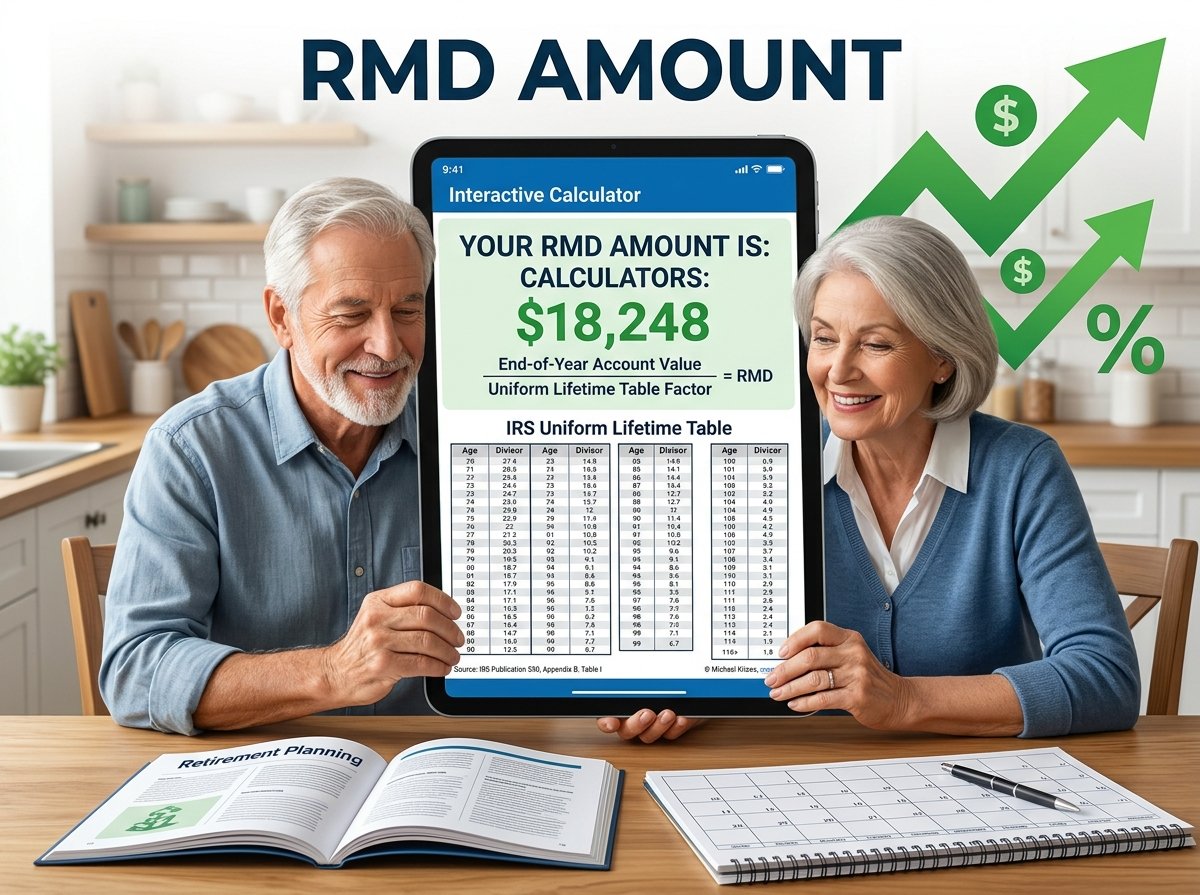
When you save money for retirement in tax-deferred accounts like Traditional IRAs, 401(k)s, or SEP IRAs, you enjoy tax breaks while working. However, the Internal Revenue Service (IRS) does not let those tax-deferred funds sit untouched forever.
The rmd amount refers to the Required Minimum Distribution—the legal minimum sum of money you must withdraw from your tax-deferred retirement savings accounts each year once you reach a specific age. Taking your minimum distribution is essential because failing to withdraw the exact required funds on time can lead to steep penalty taxes.
┌────────────────────────────────────────────────────────┐
│ ANNUAL RMD FORMULA │
│ │
│ Account Balance (Dec 31 Prior Year) │
│ ─────────────────────────────────── = RMD Amount │
│ IRS Distribution Period (Factor) │
└────────────────────────────────────────────────────────┘
Detailed Profile Overview: Understanding RMD Essentials
| Detail Parameter | Feature Description & Guidelines |
| Full Name of Concept | Required Minimum Distribution (rmd amount) |
| Governing Tax Body | Internal Revenue Service (IRS) |
| Starting Age Requirement | Age 73 (moving to age 75 for those born in 1960 or later) |
| Calculation Inputs | Prior year’s Dec 31 account balance & IRS Life Expectancy Factor |
| Standard Annual Deadline | December 31st every calendar year |
| First-Year Deadline Exemption | April 1st of the year after turning RMD age |
| Excise Tax Penalty Rate | 25% of the unwithdrawn shortfall (reduced to 10% if corrected promptly) |
| Exempt Retirement Accounts | Original Roth IRAs (and Roth 401(k)s starting in recent tax years) |
At What Age Must You Begin Withdrawing Your Mandatory Funds?
The age at which you must begin pulling funds out depends entirely on your birth year. Thanks to federal law updates under the SECURE 2.0 Act, the starting milestone was pushed back to age 73.
- If you turned 73 in 2025 or turn 73 in 2026: Your starting age for mandatory payouts is age 73.
- If you were born in 1960 or later: Your starting age shifts to age 75.
Key Takeaway: You can always take out more than the mandatory total in any given year, but you can never take less without triggering tax penalties.
Step-by-Step Guide: How to Calculate Your RMD Amount Correctly
Determining your mandatory retirement withdrawal is straightforward when you use the official IRS Uniform Lifetime Table. Follow these simple steps:
- Find Your December 31 Balance: Locate your account’s ending balance from December 31st of the previous calendar year.
- Identify Your IRS Life Expectancy Factor: Look up your age on the IRS Uniform Lifetime Table to find your corresponding distribution factor.
- Divide Balance by Factor: Divide your ending balance by your assigned IRS distribution period number.
Example Calculation (Age 74):
- Dec 31 Balance: $500,000
- IRS Factor (Age 74): 25.5
- Calculation: $500,000 / 25.5 = $19,607.84
- Required Minimum Annual Payout: $19,607.84
Important RMD Account Types: Which Ones Are Subject to Rules?
Not all savings accounts follow the exact same payout directives. Knowing which of your retirement plans require forced distributions is essential for effective tax planning.
- Traditional IRAs & Rollover IRAs: Fully subject to annual distribution schedules.
- 401(k), 403(b), and 457(b) Plans: Subject to required annual distributions.
- SEP and SIMPLE IRAs: Fully subject to standard withdrawal formulas.
- Roth IRAs: Exempt from required distributions during the original account holder’s lifetime.
Deadlines to Remember: Avoid Double-Taxation Traps
For your very first distribution, the IRS gives you a small grace period. You can delay your first withdrawal until April 1st of the year after you reach your starting age.
However, delaying your first payout creates a hidden tax trap. If you wait until April 1st of your second year, you will be required to take two minimum withdrawals in a single tax year. Taking two distributions in one year boosts your gross taxable income and could push you into a higher tax bracket.
How Are Required Minimum Distributions Taxed by the IRS?
The money you take out from tax-deferred accounts is classified as ordinary income. This means your payout is taxed at your regular income tax rate rather than lower capital gains rates.
Because mandatory payouts boost your total yearly earnings, they can also indirectly impact:
- The portion of your Social Security benefits subject to federal income taxes.
- Your Medicare Part B and Part D premium costs (via IRMAA surcharges).
- Your overall marginal tax bracket for the year.
Smart Strategies to Reduce the Tax Impact of Your RMD Amount
If you do not need your required payout for daily living expenses, you can use strategic tax tools to minimize your overall tax bill:
1. Qualified Charitable Distributions (QCDs)
If you are age 70½ or older, you can transfer up to $111,000 directly from your IRA to a qualified nonprofit charity. A direct charitable transfer satisfies your minimum payout requirement while keeping that income off your tax return completely.
2. Strategic Roth Conversions
Converting portions of your Traditional IRA into a Roth IRA before reaching age 73 lowers your pre-tax retirement balance. Lower balances mean smaller required distributions later in life.
What Happens If You Miss Your Annual RMD Deadline?
If you forget to take your full distribution amount by the December 31st deadline, the IRS imposes a severe penalty tax on the shortfall.
The standard penalty rate is 25% of the unwithdrawn funds. However, if you discover the error and quickly withdraw the missing money while filing IRS Form 5329, the penalty is reduced down to 10%.
Aggregation Rules: Can You Combine Your Accounts?
If you hold multiple retirement accounts, the IRS enforces specific aggregation guidelines:
- Multiple Traditional IRAs: You must compute the payout for every individual IRA account, but you can total those figures and withdraw the aggregate amount from just one IRA.
- 401(k) & Workplace Accounts: You must compute and withdraw the mandatory amount separately from each individual 401(k) plan.
Conclusion
Managing your rmd amount accurately each year keeps your hard-earned savings safe from costly IRS tax penalties. By understanding your starting age, calculating your required distributions on time, and exploring tax-saving strategies like Qualified Charitable Distributions (QCDs), you can keep your retirement stress-free. Always consider working with a financial advisor or CPA to ensure your withdrawals fit smoothly into your overall financial goals.
Frequently Asked Questions (FAQs)
1. What is the rmd amount?
The required minimum distribution amount is the legal minimum sum you must withdraw annually from pre-tax retirement accounts once you reach age 73.
2. Can I withdraw more than the required minimum amount?
Yes, you are always allowed to withdraw more than the minimum calculation. However, extra withdrawals in one year cannot be carried over to satisfy future years’ required amounts.
3. Are Roth IRAs subject to required minimum distributions?
Original owners of Roth IRAs are not required to take minimum distributions during their lifetime.
4. What is the deadline for taking my distribution each year?
The regular annual deadline is December 31st. First-time distributions can optionally be delayed until April 1st of the following calendar year.
5. How does the IRS penalty work if I forget my distribution?
If you fail to take your required distribution on time, you face a 25% penalty tax on the unwithdrawn amount, which can drop to 10% if corrected quickly.
6. Can I donate my payout directly to a charity to avoid taxes?
Yes, using a Qualified Charitable Distribution (QCD) lets you transfer funds directly from an IRA to an eligible charity tax-free.