
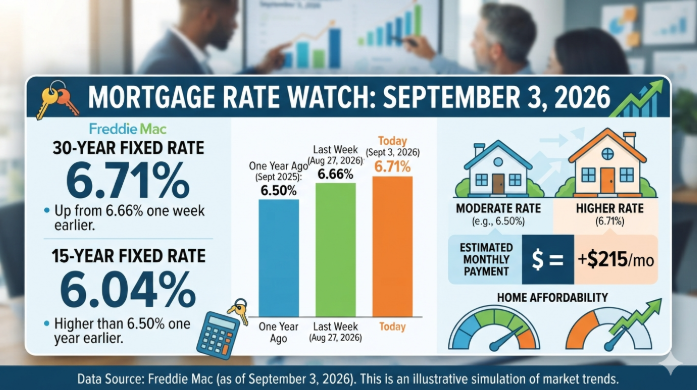
Keeping up with mortgage rates news can help you make smarter housing decisions. Mortgage rates can change your monthly payment by hundreds of dollars. They can also affect how much home you can afford. As of September 3, 2026, Freddie Mac reported an average 30-year fixed mortgage rate of 6.71%. The 15-year fixed rate averaged 6.04%. The 30-year rate was up from 6.66% one week earlier. It was also higher than the 6.50% average recorded one year earlier.
These numbers show why mortgage rates news remains important for buyers and homeowners. Rates do not move because of one single event. Inflation, Treasury yields, economic growth, and Federal Reserve policy can all matter. Your personal rate can also differ from the national average. Credit score, loan type, down payment, and lender pricing all play a role. This guide explains the latest trends in simple terms. It also shows what borrowers should watch before making a decision.
Latest Mortgage Rates News at a Glance
The latest mortgage rates news shows that borrowing costs remain elevated. Freddie Mac’s latest weekly survey put the average 30-year fixed mortgage at 6.71%. The 15-year fixed mortgage averaged 6.04%. Both rates increased from the previous week. The 30-year rate was 6.66% on August 27, while the 15-year rate was 5.98%.
It is important to understand what these figures mean. Freddie Mac’s survey uses mortgage applications from lenders across the country. It is not a guaranteed rate for every borrower. Your actual offer could be higher or lower. Market conditions also change during the week. For example, recent daily rate tracking showed some 30-year conventional rates near 6.8%.
| Mortgage Type | Latest Average | Previous Week | Key Point |
| 30-year fixed | 6.71% | 6.66% | Slight weekly increase |
| 15-year fixed | 6.04% | 5.98% | Slight weekly increase |
| 30-year fixed, one year earlier | 6.50% | — | Current rate is higher |
| 15-year fixed, one year earlier | 5.60% | — | Current rate is higher |
Why Mortgage Rates Are Moving
One of the biggest themes in mortgage rates news is the movement of bond yields. Mortgage rates often respond to changes in the bond market. The 10-year U.S. Treasury yield is especially important. When Treasury yields rise, mortgage rates often face upward pressure. Recent reporting linked higher mortgage rates with rising Treasury yields and concerns about inflation.
Economic expectations also matter. Investors watch inflation, employment, government borrowing, and economic growth. If markets expect inflation to stay high, investors may demand higher yields. That can put pressure on mortgage rates. Geopolitical events can also change investor behavior. This makes rate forecasting difficult. A major economic report can move financial markets quickly. That is why buyers should avoid making decisions based only on one day’s rate movement.
How the Federal Reserve Can Affect Mortgage Rates
The Federal Reserve is another major part of mortgage rates news. However, the Fed does not directly set the rate you receive on a 30-year mortgage. Instead, its policies can influence financial conditions and market expectations. Mortgage rates are more closely connected to longer-term bond yields than the Fed’s short-term policy rate.
When the Fed signals tighter policy, markets may expect borrowing costs to remain higher. When investors expect easier policy, longer-term yields may fall. But the relationship is not automatic. Mortgage rates can rise even when markets expect future Fed cuts. They can also fall before the Fed changes its policy. This is why borrowers should watch both Federal Reserve announcements and bond market movements. Recent reporting has highlighted continued caution around inflation and financial conditions.
What the Current 30-Year Mortgage Rate Means
The 30-year fixed mortgage remains one of the most popular choices for homebuyers. The biggest benefit is payment stability. Your principal and interest payment generally stays fixed throughout the loan term. The latest Freddie Mac average was 6.71% as of September 3, 2026.
A higher rate can have a meaningful effect on affordability. Freddie Mac provides examples showing how different rates change monthly principal and interest payments. For a $300,000 mortgage, the payment rises as the interest rate increases. Taxes, insurance, and other costs are separate.
This is why buyers should compare the full loan cost. A small rate difference may seem unimportant at first. Over many years, however, that difference can become significant. Getting multiple quotes may help you find better terms.
15-Year Mortgage Rates and Their Benefits
The 15-year fixed mortgage is another important part of mortgage rates news. Its interest rate is usually lower than the 30-year rate. Freddie Mac reported a 6.04% average for the 15-year fixed mortgage on September 3, 2026.
The main advantage is faster repayment. You build home equity more quickly because the loan ends sooner. You may also pay less total interest over the life of the loan. The tradeoff is a higher monthly payment. That payment may not fit every household budget.
A 15-year mortgage can work well for borrowers with stable income and strong savings. A 30-year mortgage may provide more monthly flexibility. The right choice depends on your cash flow, financial goals, and plans for the property. Never choose a shorter loan simply because its interest rate looks lower.
How Mortgage Rates Affect Home Affordability
Another key point in mortgage rates news is affordability. When rates rise, monthly mortgage payments usually increase. This can reduce the amount a buyer can comfortably borrow. Freddie Mac notes that lower mortgage rates can improve purchasing power because borrowing becomes less expensive.
For example, imagine two buyers shopping for similar homes. One buyer gets a lower interest rate. The other receives a higher rate. Even if they borrow the same amount, their monthly payments will differ. The higher payment could affect their budget for food, savings, repairs, and other expenses.
Home prices also matter. A lower mortgage rate does not automatically make an expensive home affordable. Buyers should look at the full monthly housing cost. This includes principal, interest, property taxes, homeowners insurance, mortgage insurance, and possible maintenance costs.
Should You Buy a Home When Rates Are High?
Many people following mortgage rates news wonder whether they should wait for rates to fall. There is no universal answer. Waiting could help if rates decline later. However, rates may also remain high or rise further. Home prices could change at the same time.
The better approach is to examine your personal finances. Can you comfortably afford the payment today? Do you have stable income? Do you have emergency savings? Is your credit profile strong? If the answers are positive, buying may still make sense.
You should also consider the home itself. A property that meets your long-term needs may be more important than trying to predict the exact bottom in mortgage rates. Nobody can reliably know the lowest future rate. Instead, focus on a payment that fits your budget.
Mortgage Refinance Rates and What Homeowners Should Know
Refinancing is another major topic in mortgage rates news. A refinance replaces your existing mortgage with a new loan. Homeowners may refinance to reduce their rate, lower their payment, change their loan term, or access home equity.
However, refinancing has costs. Closing costs, lender fees, appraisal expenses, and other charges can reduce your savings. You should calculate the break-even period before moving forward. For example, if refinancing costs $8,000 and saves $250 each month, the simple break-even period is about 32 months.
Your current mortgage rate also matters. If your existing rate is already lower than today’s market, refinancing may not make financial sense. Some homeowners may still refinance for other reasons. Always compare the total cost rather than focusing only on the advertised rate.
Credit Scores and Mortgage Rates
Your credit profile can have a major impact on the mortgage rate you receive. Lenders use credit history to assess borrowing risk. A stronger credit profile may help you qualify for better terms. Freddie Mac also notes that lenders consider personal factors such as credit when setting mortgage rates.
Before applying, check your credit reports for errors. Pay bills on time and avoid taking on unnecessary new debt. Lower credit card balances can also help your overall financial profile. However, do not make major financial changes without understanding how they could affect your mortgage application.
Remember that the national average is only a reference point. Your personal quote can differ. Two borrowers may receive different offers even when applying on the same day. Comparing lenders can therefore be just as important as watching national rate trends.
Fixed-Rate vs. Adjustable-Rate Mortgages
When reading mortgage rates news, you may also see discussions about adjustable-rate mortgages, or ARMs. A fixed-rate mortgage keeps its interest rate stable. An ARM typically starts with a fixed period before its rate can change.
ARMs can sometimes offer lower starting rates. They may appeal to borrowers who expect to move before the adjustment period begins. Recent mortgage reporting has highlighted ARMs as an option for certain borrowers in the current rate environment.
But an ARM carries more payment uncertainty. Your rate can rise after the initial period, depending on the loan terms and market conditions. Borrowers should understand the adjustment schedule, caps, index, and margin before choosing one.
For many long-term homeowners, payment stability is valuable. For others, an ARM may fit their plans. The best option depends on how long you expect to own the home.
How to Compare Mortgage Offers
Following mortgage rates news is useful, but shopping lenders is equally important. Never assume the first quote is the best quote. Contact several lenders and request comparable loan estimates. Compare the interest rate, annual percentage rate, lender fees, discount points, and estimated closing costs.
Also check whether the quoted rate is locked. A rate lock protects your rate for a specific period. The lock period and conditions can vary between lenders. Ask what happens if closing is delayed.
Do not focus only on the lowest advertised number. A lender may offer a lower rate with higher upfront fees. Another lender may provide a slightly higher rate with lower costs. Compare the complete package. This gives you a clearer picture of what the mortgage will really cost.
Mortgage Rates News and the Housing Market
Mortgage rates can influence the wider housing market. Higher borrowing costs can reduce purchasing power. Some buyers may delay purchases. Others may choose smaller homes or different locations. Sellers can also feel the effect when fewer buyers qualify for larger loans.
At the same time, housing supply and home prices remain important. A lower mortgage rate does not guarantee lower home prices. If more buyers enter the market, demand could increase. That may put pressure on prices in some areas.
The current market shows why buyers need to look beyond one headline. Freddie Mac’s recent data shows the 30-year average at 6.71%, while other daily trackers have shown slightly different figures. Rates can vary by source because surveys use different lenders, loan assumptions, and timing.
What to Watch in Future Mortgage Rates News
Several factors deserve attention when tracking future mortgage rates news. First, watch inflation reports. Persistent inflation can put pressure on interest rates. Second, monitor Treasury yields. Changes in long-term yields can influence mortgage pricing.
Third, watch Federal Reserve communication. Investors closely study statements and economic projections. Fourth, follow employment data. A strong or weak labor market can change expectations for monetary policy. Finally, keep an eye on housing demand and lender activity.
Recent Freddie Mac data shows that mortgage rates have moved higher during parts of 2026. The 30-year average rose from 6.00% in early March to 6.71% by September 3. That history shows why rates can change meaningfully over several months.
Still, short-term predictions are uncertain. A better strategy is to prepare financially and compare options when you are ready.
Practical Tips for Homebuyers
The most useful mortgage rates news is information that helps you make a decision. Start by setting a realistic housing budget. Include taxes, insurance, maintenance, and other costs. Do not base your budget only on the maximum loan amount a lender approves.
Next, improve your credit where possible. Save for your down payment and closing costs. Keep an emergency fund after closing. Then compare several lenders before choosing a mortgage.
You should also consider timing. If you find a suitable home and can comfortably afford the payment, you do not need to predict the perfect market day. If rates fall later, refinancing may become an option. That possibility should not be treated as a guarantee, though.
The goal is simple: choose a mortgage that works for your finances today and remains manageable tomorrow.
Frequently Asked Questions
What are mortgage rates right now?
According to Freddie Mac, the average 30-year fixed mortgage rate was 6.71% on September 3, 2026. The 15-year fixed rate was 6.04%. These are national averages, not guaranteed individual offers.
Are mortgage rates expected to fall?
Future mortgage rates are difficult to predict. Inflation, Treasury yields, economic growth, and Federal Reserve expectations can all influence rates. Buyers should avoid making major decisions based on one forecast.
What is a good mortgage rate today?
There is no single rate that is good for everyone. Your credit, loan size, down payment, lender, and loan type all matter. Compare several offers before deciding.
Should I wait for lower mortgage rates?
Waiting may make sense if your finances are not ready. However, nobody knows exactly when rates will reach their lowest point. If you can comfortably afford a home today, waiting solely for a future rate drop can carry its own risks.
Is a 15-year mortgage better than a 30-year mortgage?
Neither option is automatically better. A 15-year mortgage can reduce total interest but usually has a higher monthly payment. A 30-year loan offers lower monthly payments and greater flexibility.
Can I refinance if mortgage rates fall?
Yes, refinancing may be possible if you qualify. However, you should compare the new rate with your current loan and calculate closing costs. The potential savings should justify the cost of refinancing.
Conclusion
The latest mortgage rates news shows that borrowing costs remain an important issue for American homebuyers and homeowners. Freddie Mac’s September 3 data placed the average 30-year fixed rate at 6.71%. The 15-year average stood at 6.04%. These figures can change as economic conditions shift.
The smartest approach is not to chase every daily movement. Instead, understand how rates affect your payment and buying power. Compare lenders, improve your credit, review loan costs, and keep your budget realistic. If you are considering refinancing, calculate your break-even point before committing.
Most importantly, remember that national averages are only a starting point. Your actual mortgage offer depends on your financial profile and loan details. Use reliable mortgage rates news to stay informed, then make decisions based on your own long-term financial goals.